George I by Tim Blanning
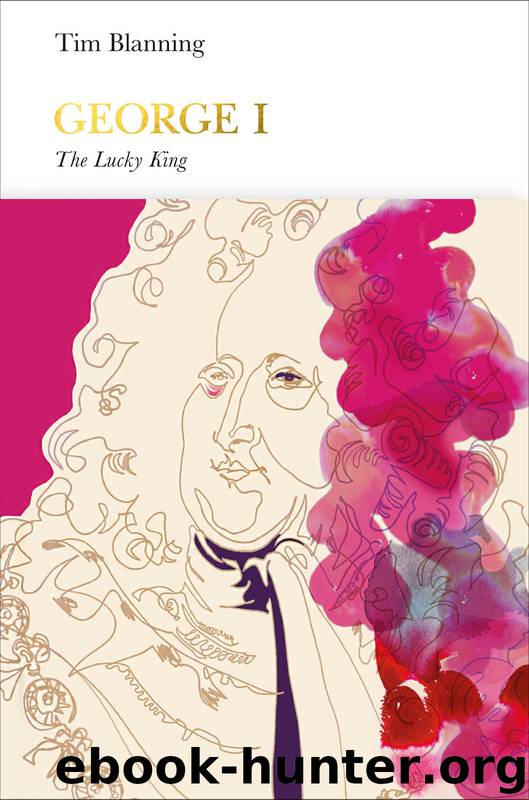
Author:Tim Blanning
Language: eng
Format: epub
ISBN: 9780141976846
Publisher: Penguin Books Ltd
Published: 2017-09-17T16:00:00+00:00
5
The Sinews of Power and Foreign Policy
George came from an electorate whose economy was modestly prosperous but torpid. In England he encountered a dynamic kingdom well on the way to becoming the workshop and counting-house of the world. When Daniel Defoe made his tour through England and Scotland, beginning in 1722, he was aware that he was travelling through a single national economy. Unlike in almost every other European country, there were no internal customs barriers. The tax imposed on coal brought to London from the north-east to finance the building of St Paul’s Cathedral was the exception that proved the rule. On leaving London in 1706, the Venetian ambassador gave this customs union the credit for putting English industry in advance of the rest of Europe.1 It was also an economy united by excellent communications, for no part of Great Britain is more than 70 miles from the coast, a natural asset supplemented by more than 1,000 miles of navigable rivers. The fact that none of the cereal-growing regions were more than two days’ journey away from access to water transport made local agricultural and horticultural specialization possible, with corresponding benefits for productivity.2 If most roads turned into glutinous mud pits when it rained, the rapid expansion after 1695 of turnpikes (which upgraded road services in return for a toll), to reach a network of about 11,000 miles by the middle of the next century, made travel and transport quicker and cheaper.3 In short, man and nature combined to create a national market, in marked contrast to England’s nearest neighbour and chief rival France, memorably described by David Landes as ‘a mosaic of semi-autarkic cells’.4
The population of England, Wales and Scotland was just short of 7,000,000 in 1714, a total that could easily be fed from local resources. England in particular had been a grain-exporting country since the 1670s and became a heavy exporter after 1714.5 Although there were good years and bad years, all the economic indicators pointed upwards, revealing increases in productivity, income, life expectancy and both physical and social mobility. Between 1700 and 1731 exports went up by 17 per cent and imports by 27 per cent. An involuntary contribution to this growing prosperity was made by the very large numbers of slaves transported across the Atlantic in British ships. In the course of the 1720s alone 211,000 were delivered, to which terrible total another 32,000 who died en route must be added. During the first quarter of the eighteenth century, the industrial economy expanded by 15 per cent, agriculture by about the same amount, overseas trade by 30 per cent, but population by only 9 per cent. A visible increase in prosperity was the result, expressed in many complacent observations. Even before the War of the Spanish Succession had set the seal on British expansion, Defoe had hailed England as the most ‘Diligent Nation in the World, vast Trade, Rich Manufactures, mighty Wealth, universal Correspondence and happy Success has been constant Companions of England, and given us the Title of an Industrious People, and so in general we are’.
Download
This site does not store any files on its server. We only index and link to content provided by other sites. Please contact the content providers to delete copyright contents if any and email us, we'll remove relevant links or contents immediately.
| Africa | Americas |
| Arctic & Antarctica | Asia |
| Australia & Oceania | Europe |
| Middle East | Russia |
| United States | World |
| Ancient Civilizations | Military |
| Historical Study & Educational Resources |
Cecilia; Or, Memoirs of an Heiress — Volume 1 by Fanny Burney(32558)
Cecilia; Or, Memoirs of an Heiress — Volume 2 by Fanny Burney(31956)
Cecilia; Or, Memoirs of an Heiress — Volume 3 by Fanny Burney(31942)
The Secret History by Donna Tartt(19090)
Sapiens: A Brief History of Humankind by Yuval Noah Harari(14389)
Leonardo da Vinci by Walter Isaacson(13336)
The Radium Girls by Kate Moore(12028)
Sapiens by Yuval Noah Harari(5372)
How Democracies Die by Steven Levitsky & Daniel Ziblatt(5219)
The Wind in My Hair by Masih Alinejad(5095)
Homo Deus: A Brief History of Tomorrow by Yuval Noah Harari(4918)
Endurance: Shackleton's Incredible Voyage by Alfred Lansing(4783)
Man's Search for Meaning by Viktor Frankl(4606)
The Silk Roads by Peter Frankopan(4534)
Millionaire: The Philanderer, Gambler, and Duelist Who Invented Modern Finance by Janet Gleeson(4478)
The Rape of Nanking by Iris Chang(4213)
Joan of Arc by Mary Gordon(4112)
The Motorcycle Diaries by Ernesto Che Guevara(4102)
Stalin by Stephen Kotkin(3968)
